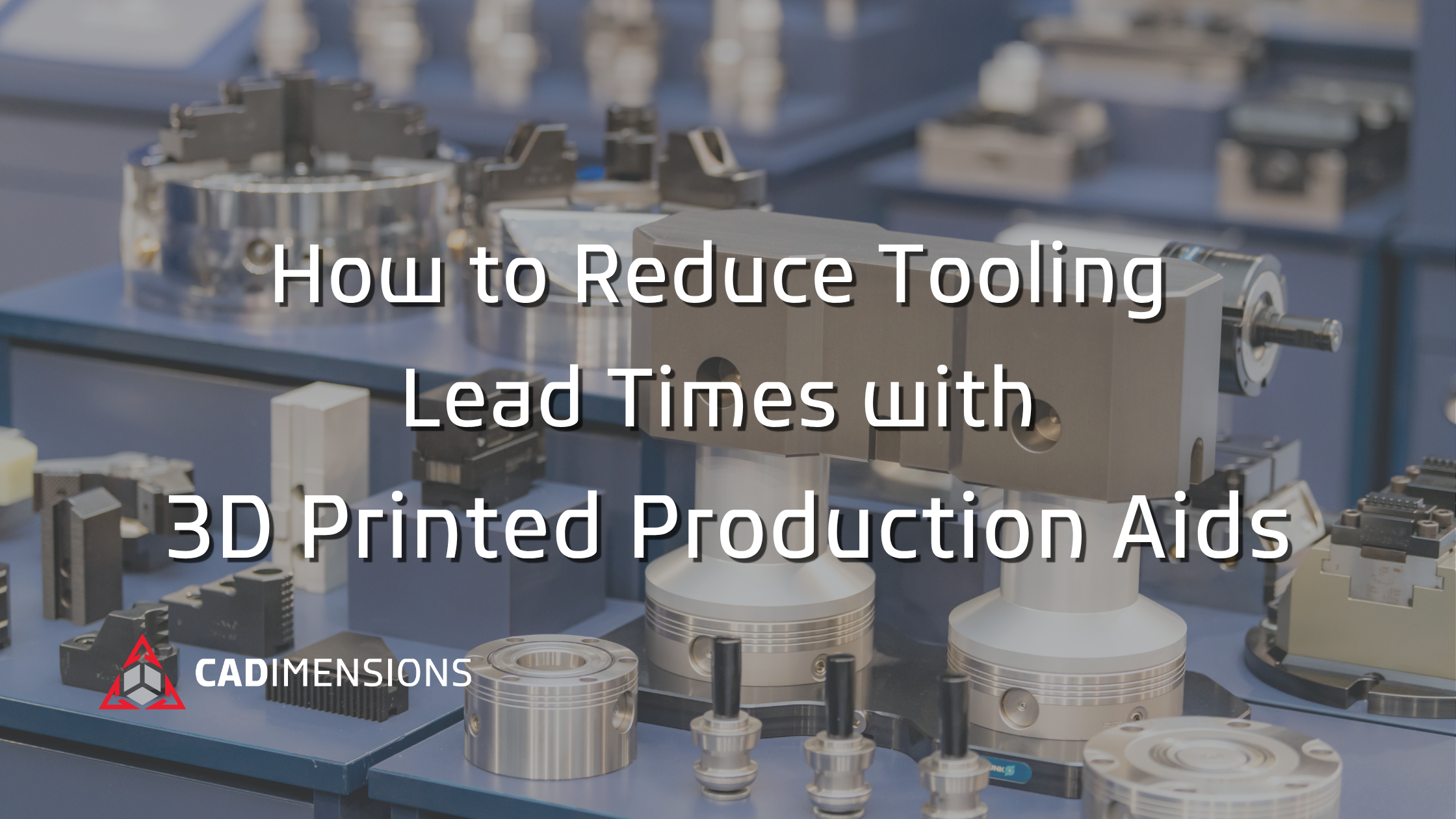
Long tooling lead times can delay new products, tie up machining capacity, and make it harder to respond when production needs change.
3D printed production aids give manufacturers another option. For the right applications, additive manufacturing can shorten lead times, help optimize designs, and reduce dependence on traditional tooling workflows.
The key is knowing where 3D printing makes sense. Tool performance still depends on factors such as load, temperature, wear, chemical exposure, and required service life. But when the application is a good fit, additive can shorten tooling lead times without sacrificing the function the production floor needs.
.png)
Why Tooling Lead Times Become a Production Problem
Tooling delays can affect far more than the tool itself. A fixture that arrives late can slow a changeover, delay a new product launch, hold up a repair, or make a low-volume job harder to justify.
Outsourcing can add supplier and procurement lead times, while producing tooling in-house can create a different constraint: every hour a CNC machine spends making a fixture is time it is not producing parts.
That can show up in the metrics manufacturing teams track every day, including cycle time, throughput, and cost per part. For the right applications, additive manufacturing can alleviate these tooling delays and help teams to get production aids in place faster and respond more quickly when requirements change.
Will 3D-printed tools hold up in production?
One of the first questions manufacturers ask is whether a 3D-printed tool can withstand a production environment. The answer depends less on whether the tool is printed and more on whether the material and design match the application.
Key factors include load, temperature, wear, chemical exposure, ESD requirements, geometry, biocompatibility, FST rating requirements, and expected tool life. Different technologies and material families can support very different requirements. To determine the best fit, start with the operating environment and what conditions the tool is subjected to, then choose the process, material, and design accordingly.
Choosing the Right Technology and Material for 3D Printed Tooling
The right 3D printing technology and material depends on what the tool needs to do and the environment it will operate in. Temperature, chemical exposure, stiffness, wear, part size, and surface requirements can all influence which 3D printing technology is the best fit.
Fused Deposition Modeling (FDM) is often a strong choice for larger tools, rugged fixtures, and applications that benefit from engineering-grade or high-performance thermoplastics. It is especially useful when part size, structural performance, or chemical and temperature resistance are priorities.
Stereolithography (SLA) is typically better suited for smaller tools that need fine detail, smooth surfaces, tight feature definition, or complex geometry. It can be a good fit for precision jigs, fixtures, molds, and other applications where surface quality and dimensional accuracy matter.
Selective Laser Sintering (SLS) is useful for durable production aids with complex geometries, especially when eliminating support structures is an advantage. Because parts are supported by the excess powder during printing, SLS can produce intricate, functional shapes that are well suited for jigs, fixtures, housings, replacement parts, and other shop-floor tools.
Use Cases for 3D Printed Production Aids
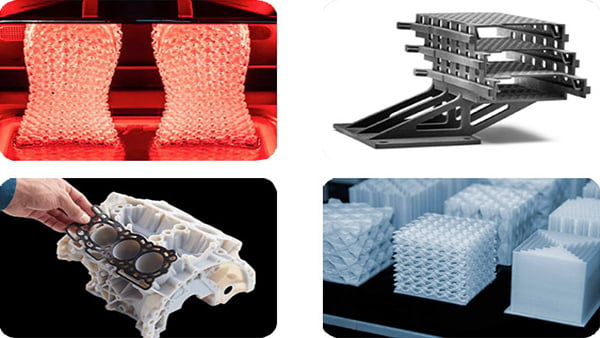
3D printed production aids can support a wide range of manufacturing tasks, from simple alignment tools to more specialized fixtures and molds. The best opportunities are usually applications where speed, customization, weight, or design flexibility matter.
Assembly jigs and fixtures
Jigs and fixtures are among the most common production-aid applications for 3D printing. They can be used for alignment, welding, drilling, fastening, and assembly while being easier to customize than traditionally machined tooling.
Red Oak Fabrication uses Formlabs' Rigid 10K Resin to produce welding jigs with complex geometries. In one comparison, a 3D-printed jig cost about $100 and was delivered in days, compared with roughly $1,000 and months for a CNC-machined alternative.
Inspection and checking fixtures
Go/no-go gauges, locating nests, and checking fixtures can help operators verify placement and repeatability without relying on manual measurement alone.
At Productive Plastics, Formlabs' SLS technology is used to produce locating jigs for assembly. One fixture helped operators place blocks on a thermoformed part to a specified .003-inch tolerance while reducing time previously spent machining or correcting placement.
End-of-arm tooling
3D printing can also be useful for robotic grippers and other end-of-arm tooling where low weight and application-specific geometry are important. Lightweight structures, custom contact surfaces, and integrated features can help reduce payload while making it easier to adapt tooling for different parts or production changes.
Eaton’s Olean plant uses Formlabs SLS to produce EOAT components in Nylon 12 Powder that are lighter, easier to change, and quicker to replace than machined alternatives. This also means shorter cycle times and more throughput. Eaton also redesigned other robotic handling components to be lighter and easier to change, taking advantage of SLS geometry rather than simply reproducing the original machined tools.
Ergonomic aids
Operator-handled tools can benefit from reduced weight , improved grip geometry, and smoother surfaces. Valiant TMS used a Stratasys Origin One to produce part of a manually operated automotive tool using Loctite 3D 3172. Because the tool is handled for up to eight hours per day, weight and surface finish were important design considerations. The additive version could be produced in about five hours, compared with roughly two days using a five-axis CNC machine.
Low-volume molds and forming tools
Additive manufacturing can also extend beyond simple fixtures. Northrop Grumman used Stratasys FDM technology to produce large polymer tooling for a rocket motor application, demonstrating that 3D-printed tooling can support more demanding forming and molding processes when the material and design are matched to the environment.
What Manufacturers Are Achieving With 3D Printed Tooling
Northrop Grumman: From About a Year to Six Weeks
Northrop Grumman faced tooling lead times that could stretch beyond a year because of delays sourcing large forgings, castings, and weldments. The team used Stratasys FDM technology and Antero 840CN03 to produce large-format rocket motor tooling in-house. The result was a reduction in fabrication time from about one year to six weeks.
Red Oak Fabrication: From $1,000 to $100
Red Oak Fabrication faced a different tradeoff. Simple sheet-metal fixtures were inexpensive but less precise, while CNC-machined fixtures provided better accuracy at higher cost and longer lead times. By producing welding jigs with Formlabs SLA and Rigid 10K Resin, Red Oak reduced a representative tool from about $1,000 to $100 and from months to days.
3D printing can make low- and medium-volume tooling more economical while also allowing more complex, application-specific geometry.
When Does Additive Make Sense?
Additive manufacturing is a strong fit when traditional tooling takes too long, quantities are low, designs change frequently, or complex geometry makes machining expensive. It can also be useful when manufacturers want to reduce CNC demand, lightweight a tool, or create replacement tooling quickly.
Traditional tooling may still be the better choice when loads are especially high, continuous temperatures exceed polymer capabilities, extreme wear determines tool life, or required tolerances and long-term economics favor machining.
3D printing production aids enables manufacturers to stop machining tools that do not need to be machined and free valuable CNC capacity for production work.
Next steps for manufacturers
A good place to start is with one tooling bottleneck already affecting production. Look for a fixture that takes too long to source, a tool that repeatedly ties up CNC capacity, a production aid that changes often, or a low-volume tool that is difficult to justify with traditional manufacturing.
From there, document the application requirements, including temperature, load, chemical exposure, ESD and other unique property needs such as biocompatibility and FST rating, tolerances, expected cycles, and required lead time.
CADimensions’ team of 3D printing experts can help evaluate whether additive is the right fit, recommend the appropriate process and material, review the design for manufacturability, and produce the finished tool.
Not sure if your tooling application is a fit? Talk to a CADimensions additive manufacturing expert.
.png)