Industrial equipment manufacturing is changing rapidly in 2026. Supply chain volatility and skilled labor shortages continue to impact the industry. New technologies, evolving regulations, and shifting business models are changing how products are designed, produced, and supported.
At the center of this shift is a more connected, digital, and resilient manufacturing ecosystem. Additive manufacturing plays a growing role. In this article, we’ll break down the top trends shaping industrial equipment manufacturing in 2026, and what they mean for your design process, production floor operations, and business strategy.
1. AI-Driven Manufacturing & Smarter Supply Chains
Industrial equipment manufacturers are moving beyond basic automation to AI-driven decision-making across operations. This shift is part of a broader surge in digital transformation, with global spending expected to approach nearly $4 trillion by 2027, according to the International Data Corporation. AI is now being applied to demand forecasting, production scheduling, and supply chain management to optimize productivity and workflows.
Applied strategically, adopting AI in the right places means
.png)
2. Resilient, Distributed Manufacturing Models
Global disruptions have forced manufacturers to rethink traditional supply chains. Rather than rely on single-source suppliers, companies are shifting toward multi-sourcing strategies, nearshoring and regional production, and digitally-enabled supply networks. Additive manufacturing enables industrial equipment manufacturers to combat increasing supply chain volatility.
A few solutions additive manufacturing provides that strengthen supply chain resilience include:
- On-demand spare parts production
- Reduced dependency on long-lead tooling
- Localized manufacturing for critical components
3. Additive Manufacturing Moves Beyond Prototyping
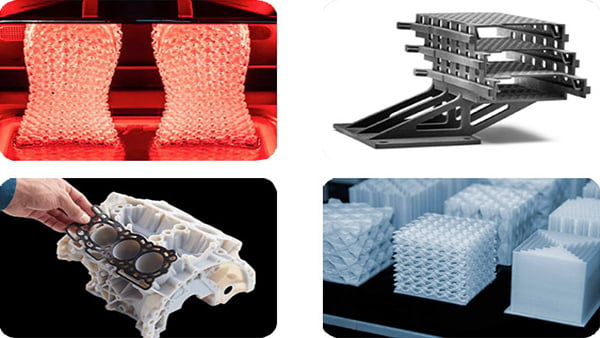
The benefits of additive manufacturing go beyond prototyping, making it a production and supply chain solution. Driving this shift is the increasing need for faster lead times, higher demand for customization, and the pressure to reduce tooling costs. Companies like Siemens Mobility are using additive manufacturing to produce replacement parts on demand, significantly reducing turnaround times compared to traditional methods.
Where additive delivers value:
- Tooling, jigs, and fixtures
- Low and High-volume production
- Spare parts and obsolescence management
4. Workforce Gaps Driving Automation & Digital Tools
In 2026, industrial equipment manufacturers are facing workforce challenges, including labor shortages, skills gaps in advanced technologies, and an increasing difficulty in filling critical roles. According to Deloitte’s manufacturing workforce analysis, hundreds of thousands of roles remain unfilled, with millions more needed in the coming decade. These workforce challenges are not temporary, and a structural shift is needed to overcome them.
Additive manufacturing provides that long-term solution by:
- Reducing manual tooling processes
- Simplifying production workflows
- Enabling faster onboarding with digital processes
5. Design for Additive Manufacturing (DFAM) Becomes Critical
DFAM for industrial equipment manufacturers empowers teams to:
- Reduce part count and failure points
- Optimize material usage
- Improve product performance beyond traditional methods
6. Cybersecurity and Digital Protection
As manufacturing becomes more digitally connected, cybersecurity is a core product requirement. New global regulations, such as the EU Cyber Resilience Act, introduce cybersecurity requirements across the product lifecycle, with reporting obligations beginning in 2026.
Additionally, additive manufacturing introduces a dual supply chain involving both physical materials and digital build files. Securing both is critical for IP protection, production integrity, and compliance.
7. Regulatory and Compliance Landscapes Are Expanding
The regulatory and compliance landscapes in industrial equipment manufacturing are constantly shifting. In addition to new global policies like the Carbon Border Adjustment Mechanism (CBAM), which introduces carbon cost accountability in 2026, U.S. industrial equipment manufacturers are navigating frameworks such as NIST cybersecurity standards, CMMC, ITAR, and ISO requirements, driving higher demands for traceability, data security, and documentation. Additive manufacturing supports these needs through digital workflows, improved traceability, and more localized, controlled production.
If you're evaluating how to align your processes with these requirements, explore our IT Compliance Cheat Sheet for a practical starting point.
8. Sustainability, Energy Efficiency, and Waste Reduction
With increasing regulatory pressure, cost implications of energy usage and waste, and a growing customer demand for sustainable solutions, sustainability is increasingly a key business driver in 2026. Integrating additive manufacturing enables manufacturers to keep up with those demands.
Additive manufacturing supports sustainability by reducing material waste through more efficient production, enabling lightweight designs that improve energy efficiency, and extending product lifecycles through repair and remanufacturing, helping manufacturers lower both environmental impact and total cost of ownership.
For a deeper dive into sustainable additive technologies, learn how powder bed fusion is shaping sustainable manufacturing.
How Additive Manufacturing Helps Your Team Turn 2026 Trends into Results
For Design & Engineering Teams
- Accelerate iteration cycles and validation
- Design more complex, high-performance components
- Reduce constraints tied to traditional manufacturing
For Manufacturing & Production Teams
- Reduce tooling lead times
- Improve flexibility and responsiveness
- Lower scrap and downtime
For Business Operations & Leadership
- Strengthen supply chain resilience
- Improve ROI through smarter investments
- Enable scalable, future-ready production strategies
Designing for What’s Next
The manufacturers who adapt fastest will lead. The future of industrial equipment manufacturing is more agile, more digital, and more connected. Success will depend on how well your team turns these trends into action.
Additive manufacturing isn’t a standalone solution. It’s a strategic capability that helps you accelerate innovation, build more resilient supply chains, and make smarter, long-term investments. The challenge isn’t just knowing where the industry is headed but knowing how to apply the right tools to your specific workflow.
Not sure where to start? Request a hardware consultation. Our experienced additive manufacturing specialists take the time to understand your business and help you identify the right solution so you can invest in the right hardware, at the right time, for your team.
Because tomorrow is designed today.
Frequently Asked Questions
What is additive manufacturing and how is it used in industrial equipment manufacturing?
Additive manufacturing is the process of building parts layer by layer from a digital file. In industrial equipment manufacturing, it is used for tooling, jigs and fixtures, low- and high-volume production, and on-demand spare parts. This reduces lead times and tooling costs compared to traditional methods.
How does additive manufacturing help with supply chain resilience?
It allows manufacturers to produce parts on demand, reduce dependency on long-lead tooling, and localize production of critical components. That flexibility makes it easier to respond to disruptions without halting operations.
What is Design for Additive Manufacturing (DFAM)?
DFAM is the practice of designing parts specifically to take advantage of what additive manufacturing can do. That includes complex internal geometries, lightweight structures, and part consolidation. These are outcomes that are not achievable with traditional manufacturing methods.
How does additive manufacturing address workforce shortages?
By reducing manual tooling processes, simplifying production workflows, and enabling faster onboarding through digital processes, additive manufacturing helps teams do more with fewer specialized labor hours.
Where do I start if I want to integrate additive manufacturing into my operations?
The best starting point is understanding which parts of your workflow have the most to gain. Our additive manufacturing specialists can walk you through that process and help you identify the right hardware for your specific production goals. Request a hardware consultation to get started.